Between the years of 1490 and 1527, Italian High Renaissance Art was solely focused on religious stories. Also, artwork from this time was more complex regarding the figures in these pieces. For example, Leonardo Da Vinci’s The Last Supper relies heavily on perfect geometry and composition to show how divine Christ and all the apostles were. Da Vinci used linear perspective in this painting to make the meaning more spiritual. Also, by placing the apostles in groups of three, he represented the holy trinity; the father, the son, and the holy spirit.
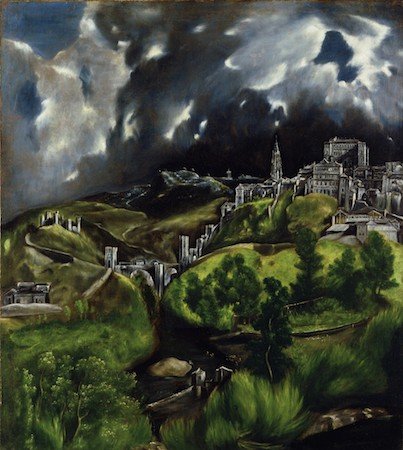
From Italian High Renaissance Art sprouted Mannerism and Baroque Art. Mannerist artists focused on making their art artificial, in other words, artwork of the Mannerism period pushed the boundaries between imagination and realism. Artists would often reference other artwork rather than use a real-life reference or, they would paint what they thought something looked/felt like. One example of this is El Greco’s View of Toledo. While making this painting, Greco, “rather than telling us what Toledo looked like, here, El Greco communicates what the city feels like.” (Zappella).
)
El Greco, View of Toledo, date unknown, oil on canvas, 47-3/4 x 42-3/4 inches / 121.3 x 108.6 cm (The Metropolitan Museum of Art)
This is a good example of a Mannerist Artist using their imagination to create their piece instead of painting what they saw in real life. This theme in art is my favorite because art is not supposed to look nice, it is supposed to make you feel something, and this painting makes you feel like you are in the city with El Greco. Greco perfectly portrayed the uneasiness of this city.
Italian Baroque art, also Barrueca in Spanish, consisted of artwork that showed the natural state of an item but also, an artificial one. There were three classifications of Baroque art: Classicism, Realism, and Theatrical. Baroque realism was often lighter images of people or things from nature with a darker background. Baroque classicism consisted of biblical images. Lastly, Baroque theatrical was always 3D artwork or sculptures.
Different techniques of this time were fitting examples of the differences between the High Renaissance and Baroque art. These techniques included “painterliness—loose brushwork, blurred contours, and color over line; expansiveness—the impression that the artwork continues beyond its borders, oftentimes through the use of diagonals; and uncertainty—the emphasis on how things appear instead of how they are.” (Ripollés) While renaissance art consisted solely of linearity.
Leave a Reply