Problem: Create a modular object while considering how water moves through an object and working to create and glaze a larger object.
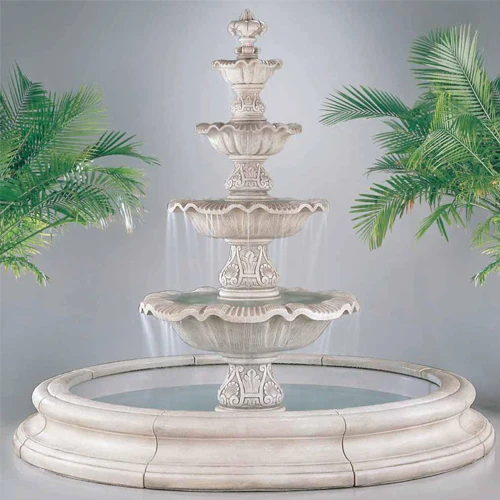
When you are told to imagine a fountain, I bet the first image that comes to mind is a fancy lawn fountain where the water spews out from the top layer and drips down to the layers below and collects in a bowl and recycles the water. This is the most common type of fountain which is why it might have come to mind. For this problem I wanted to cross the line of the fancy lawn fountain and create something that would connect to the natural world.
The first step I took to create this piece was a sketch. I have learned over the years that 3D is sometimes best imagined on paper. I can draw the different angles and sides to get a broad idea of what is going on inside my mind. It is the same as an essay and sometimes having a blank piece of paper is easier to manage than having a blank computer screen or in this case a ball of clay and tools.

To explain this sketch a little bit, I wanted to create a female torso that would sit in a wide bowl that would act as the base and as a pond structure. The water would come out of the flowers and tree branches that I would add on the torso once the figure was completed. The water pump would sit inside the torso so that it was hidden, and the hose would sit on a shelf built inside the torso so that the water could slide down on the inside and come out of each flower and branch.
To make the base and the torso, I decided wheel thrown vessels would be the best way to tackle this problem. I started by throwing the base to see how large I could make it. This would help me decide how large to make the vessels for the torso.

The thrown base came out to 13″ wide. The depth did not matter since I had not decided how high I wanted the flowers that would spew the water to be. I had also decided that I wanted to add some decoration to the base so that it was not simple. Since I wanted it to model after a pond, I figured rocks were the best solution.

I figured some color was needed on the rocks as well. Something extra too, which is where Ms. Toad came in. If you have rocks, a pond, and water then what is stopping a toad from being in the vicinity?

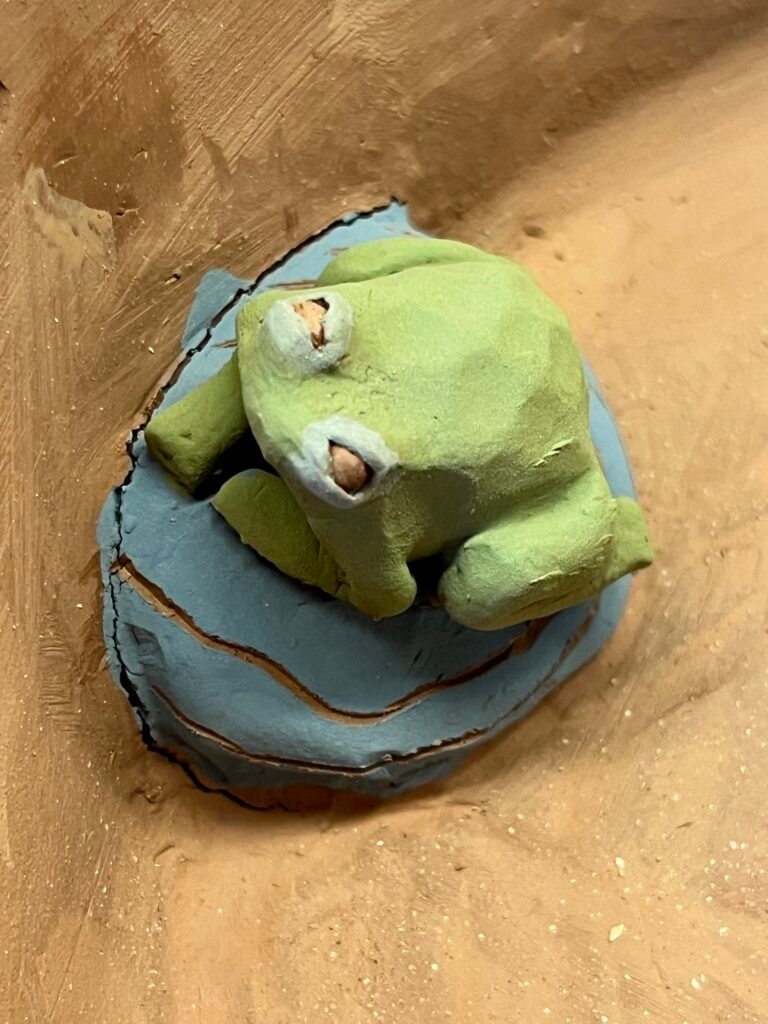
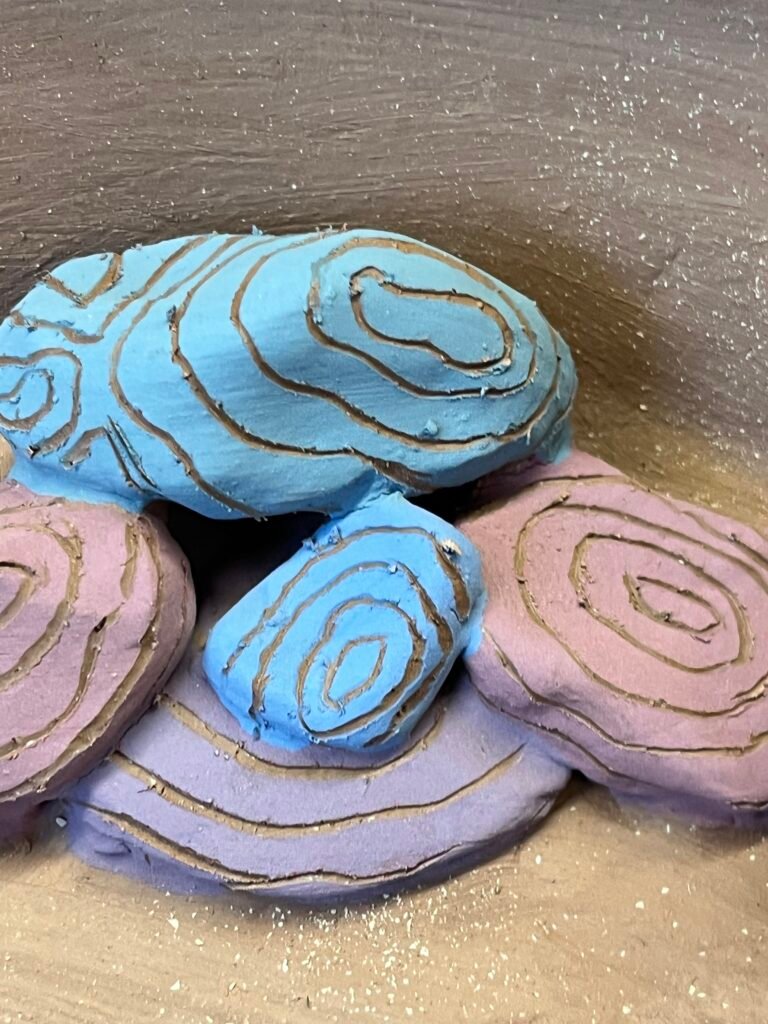
I wanted the rocks to be a combination of real rocks and crystals since I was not aiming for realism.

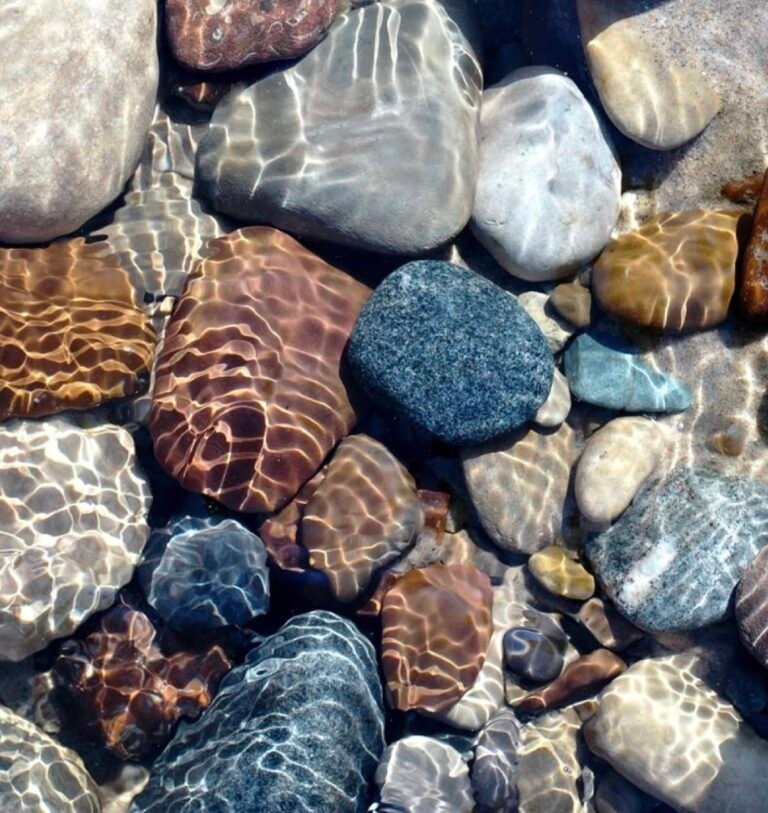
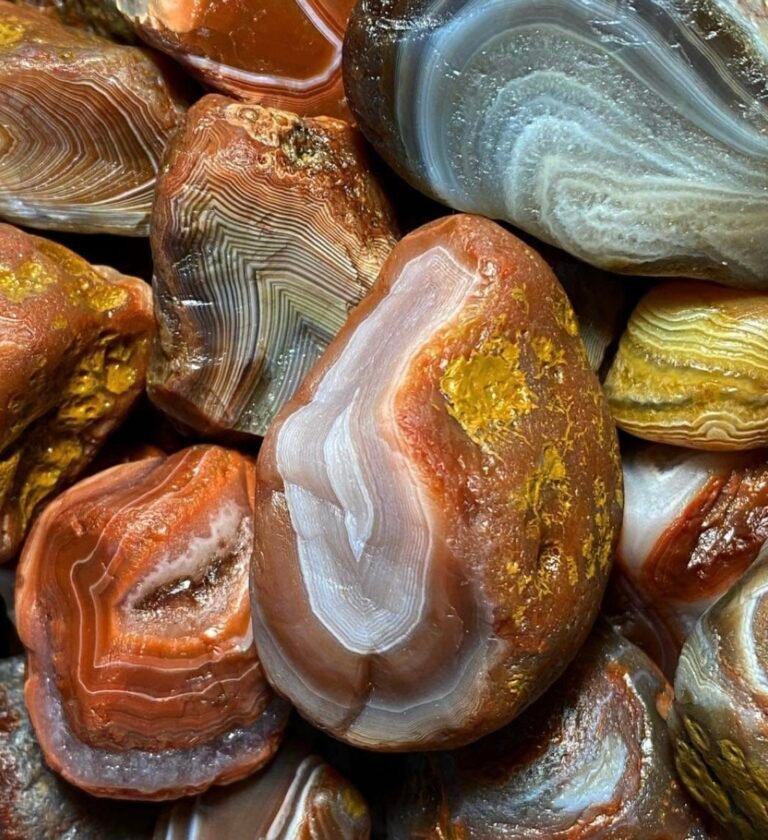
To complete the base, I added a light teal color that would fit in with the colors of the rocks but also stand out since I used a lot of blues and pinks.

I had hoped that the clear glaze would cloud in some areas, adding another level of naturalness to the pond base. Luckily, the clear glaze also sealed the crack that had formed where Ms. Toad sits on her rock. This was a worry of mine since the water would sit in the base and could seep through the crack which would make the table or surface wet and drain the needed water the pump would use.
To make the torso I had thrown four vessels that I would use coil and slabs to connect to each other. I threw two identical tumbler shapes for the legs and two wide bowl shapes for the upper part of the body.
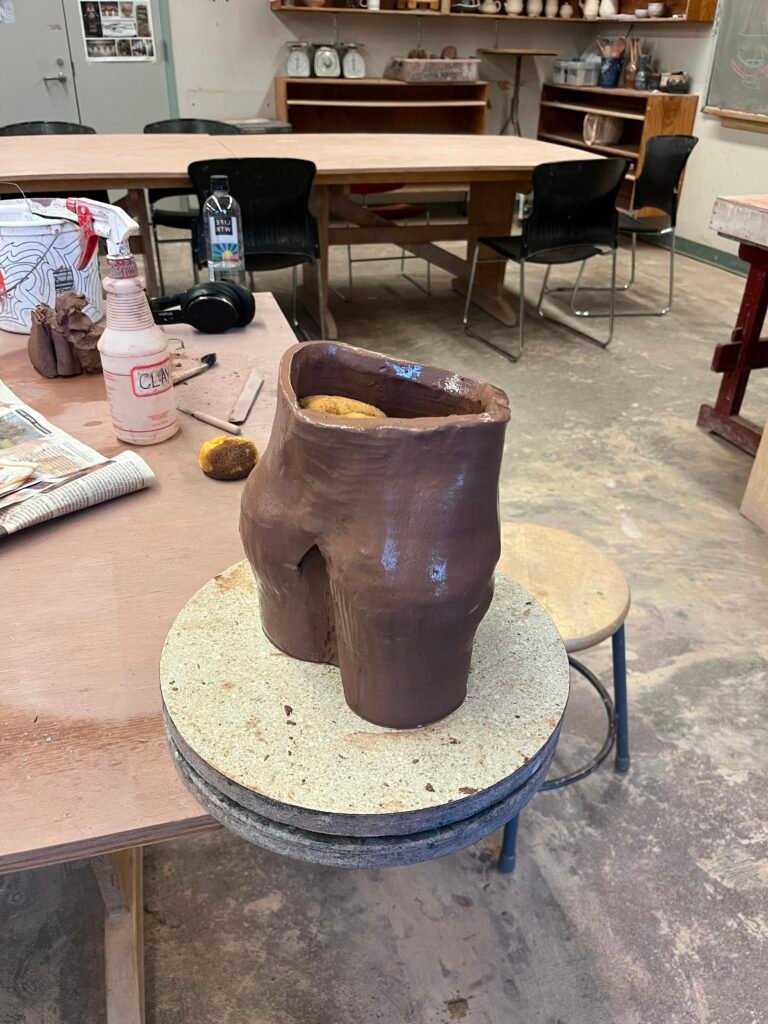
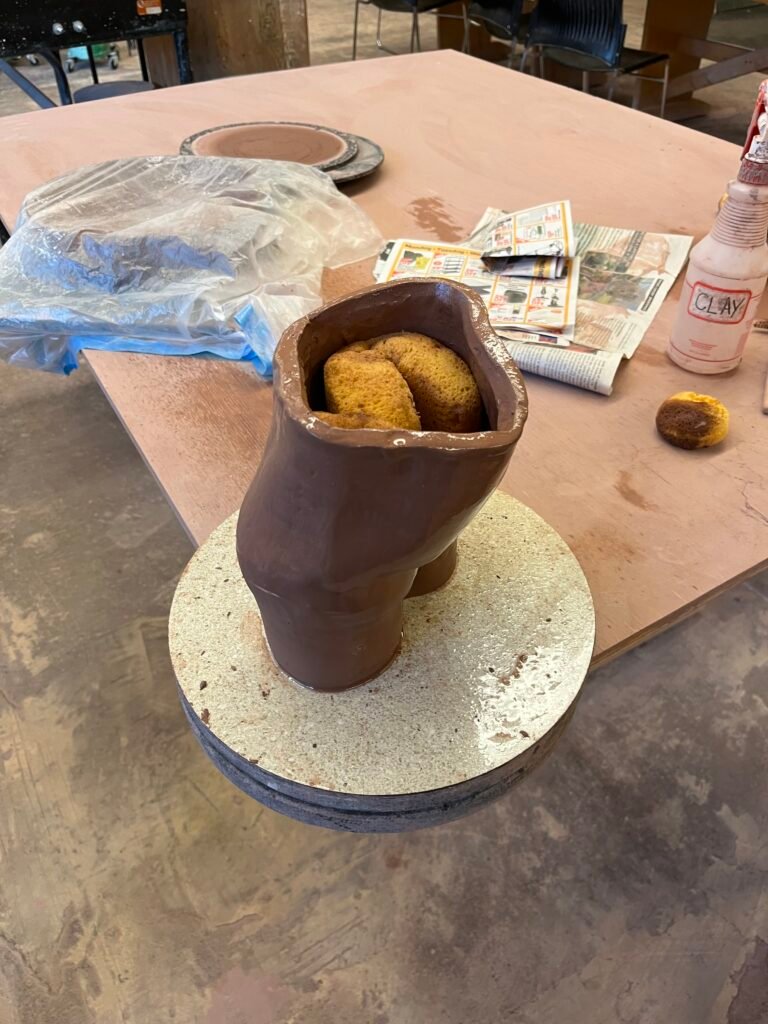
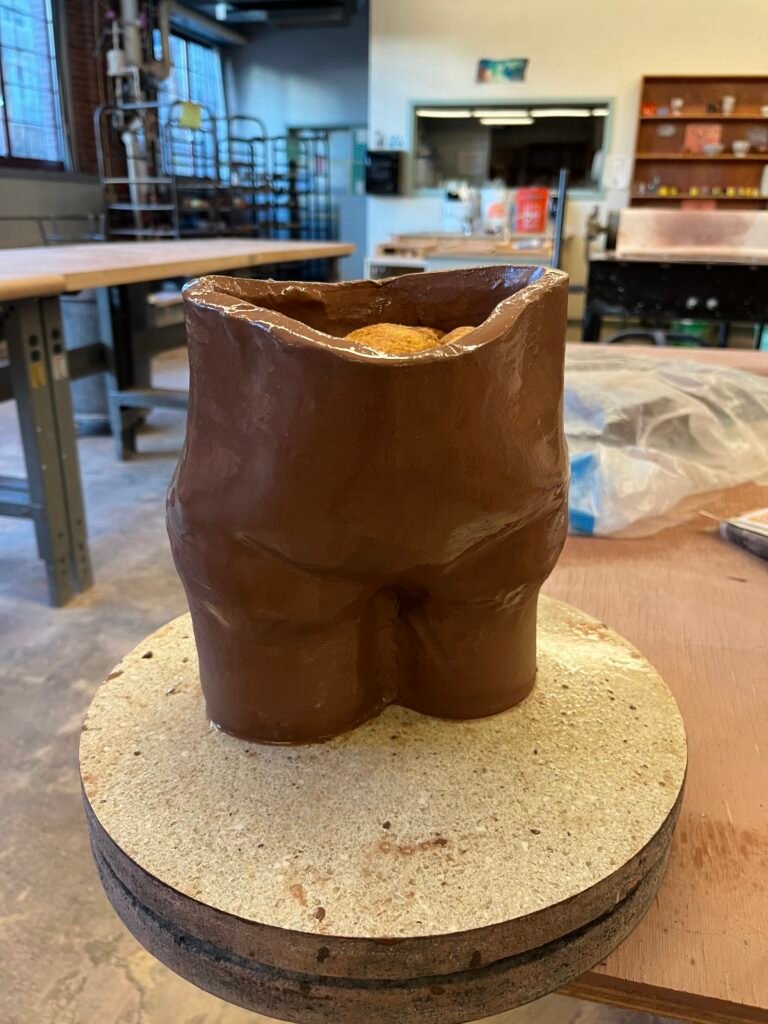
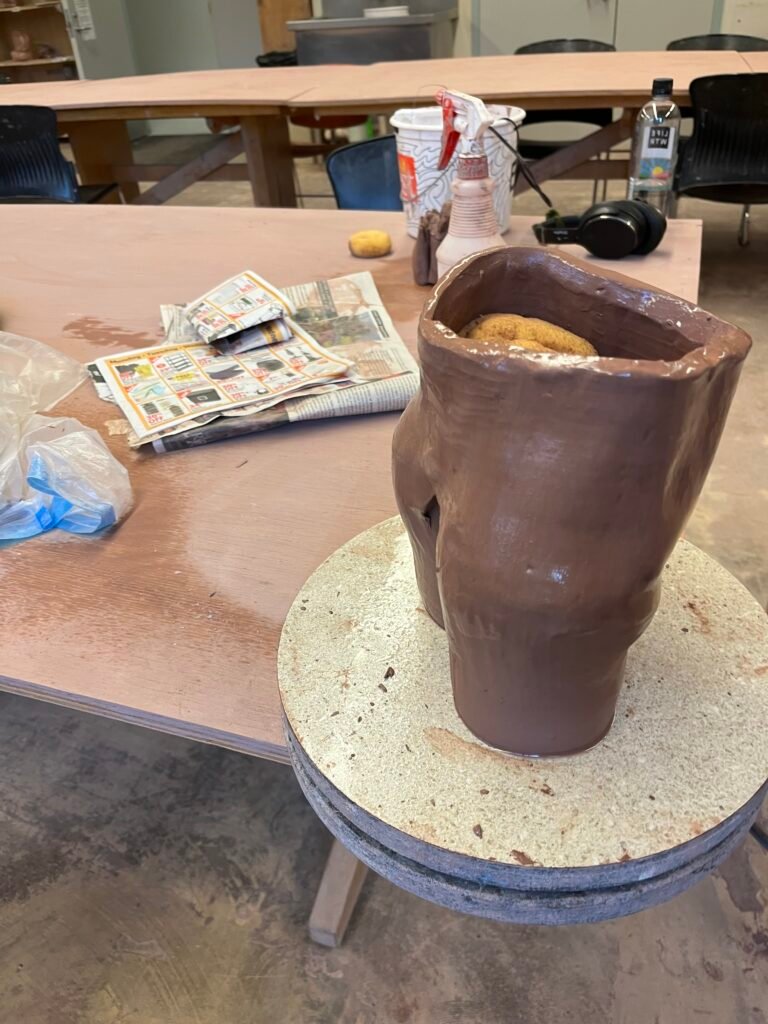
As you can see in these pictures the clay is very thick which makes it hard to keep the body in shape and to keep it standing up right. To try and counter this issue, I squished sponges inside of the vessel to keep the shape and to add some structure while the clay began to dry and warp.
I had a tricky time creating the torso area that was attached to the legs because of how wet and heavy the clay was when I was working with it. Also, trying to attach the clay while making sure it did not rip was another tricky part. After attaching the torso to the legs, I went through both bowl forms that I threw since the first time I tried to attach it, the clay ripped in half and fell off the form. Another issue I encountered was keeping the clay wet, but not too wet because the legs would crush under the weight and wetness of the clay and the form would fall forward. I moved the form to a ware board so that the wood would soak up the excess water.
To build the torso up, I used wide slabs to add on to the top of the form. As I was building the form up, I went through and shaped the form as much as I could to make it look more like a torso. Once I decided it was tall enough, I ran into another issue. The top of the form was too pronounced which caused the balance to be off and the form would rock back and forth when bumped even a tiny bit. I wanted to avoid my creation falling over from the weight, so I had to do some surgery. I removed a sliver of the clay from the sides and the front the same way you would sew a dart with fabric. Doing this helped reduce the amount of unbalance and fixed the weight distribution. It also helped me with the shaping of the chest of the torso. After this surgery, I decided it was no longer a gender identifying torso, it was androgynous.

This is the form after adding branches and flowers and a water slide. It was at this point that I decided that I did not want to have water come out of the flowers and different areas of the branches. Truth be told I had been working on this stage of the form for a couple of hours, and I had hit the point where I could not work on it any longer.
The water would come out of the left side, go down the slide and fill the pond base. For the water to reach the motor/pump which sits inside of the left leg of the form, I carved two holes in the front of the legs for the water to fill up the inside of the form. There is also another hole in the bag of the legs for the motor cord to reach out, this way the pump was not visible at all.

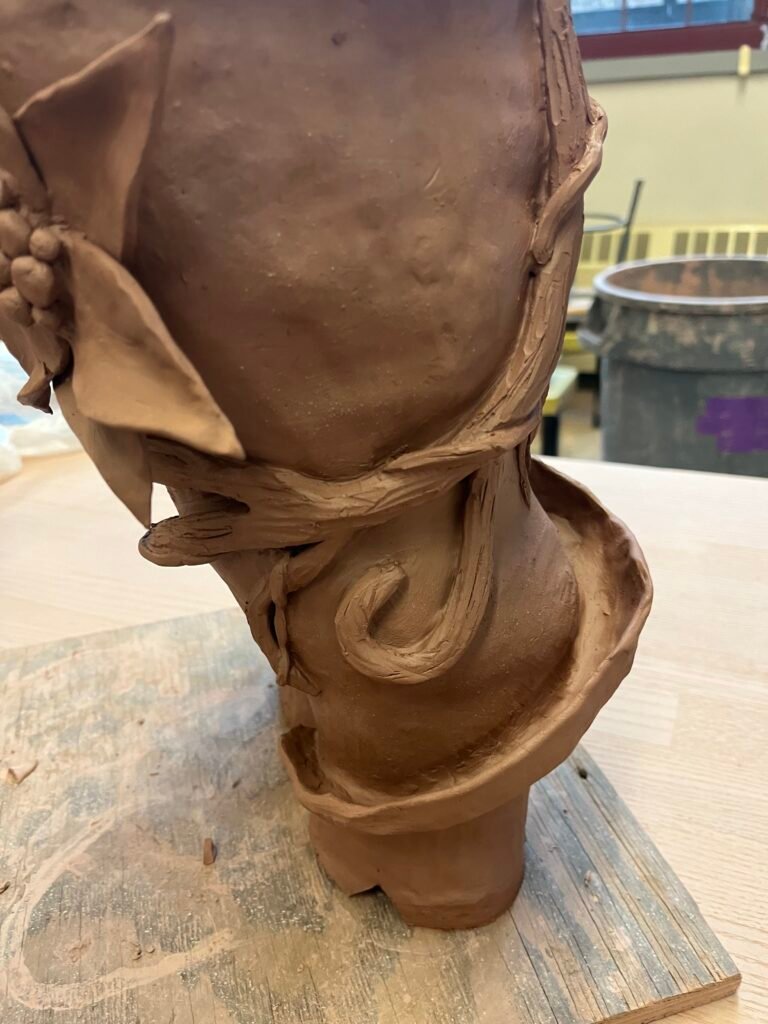
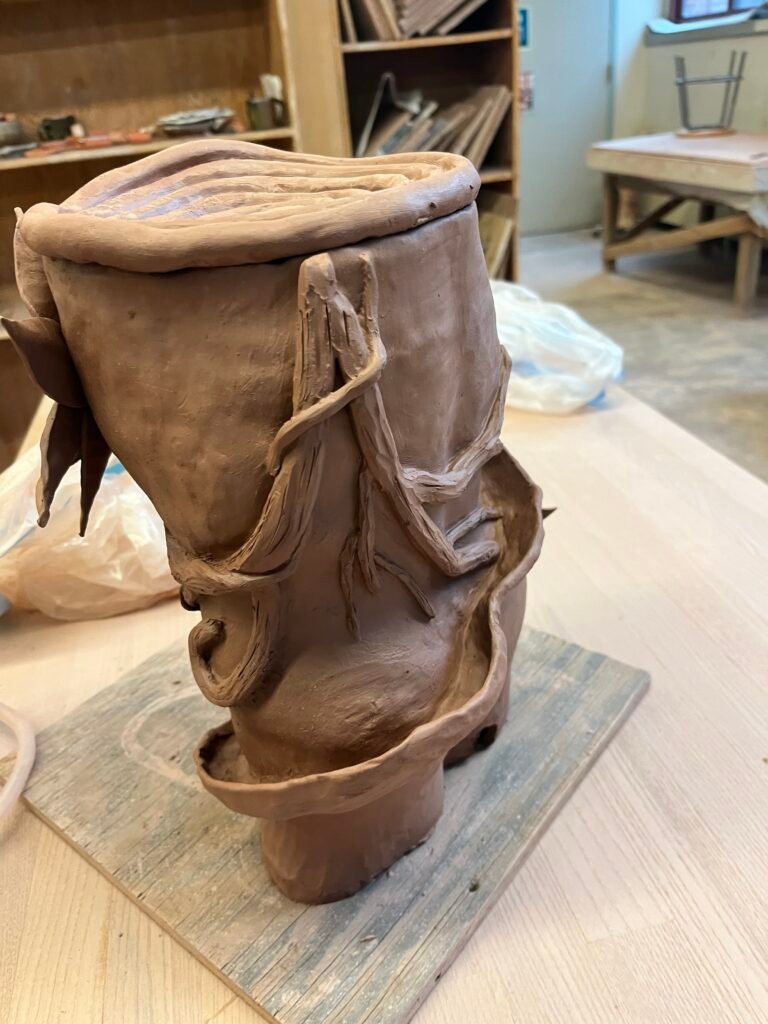

After completing the form, I realized that you could look in and see the pump and hose. Not a huge deal, but for this specific piece I did not want it to be visible. So, I created this coil cover to place on top of the piece. Also, I carved a hole through the middle of the piece in hopes to stick the hose though the hole and have the water drip down the sides of the form as well as drip down the water slide. Unfortunately, this idea did not work because the water pressure was either too hard and the water spouted out and made a mess, or the water pressure was too low and did not produce enough for it to glide down the sides of the torso.


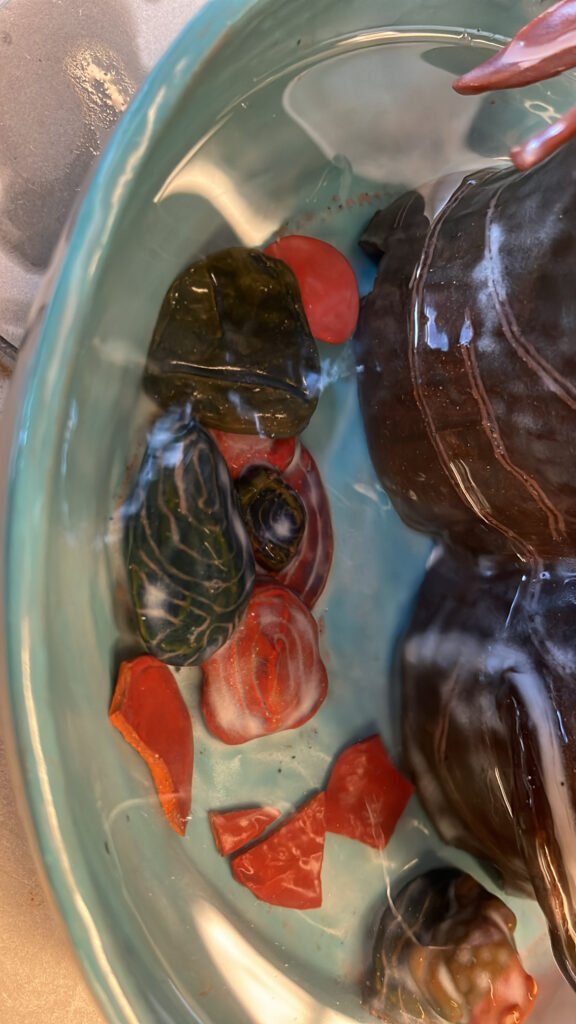
The above images are of the completed piece. Meaning glazing was done, the forms were assembled, and water was added to the fountain. Overall, I am incredibly pleased with how it turned out. I love how the torso is dark and earthy and then the pond is bright colored which adds to the contrast between the two. There could be slight improvements in how the water is produced, but it proved to be a successful solution to a problem.
For this problem, my main goal was to break the lines of comfortability among art students. Usually, nude art is not practiced for reasons that I do not know. But, with this piece I wanted to try, after all the human figure is the most natural form of them all. Sure, you can sculpt and workout and eat the right diet but everything about the figure is inherent.
Leave a Reply